The next-generation valence bond electronic structure software XMVB2026 is officially released today!
Published Time: 2026-11-21 14:14:54
As a free and open software package, XMVB 2026 aims to build an open, user-friendly integrated platform for computation and analysis, providing researchers with a complete toolkit covering electronic structure calculations to chemical bond analysis. New features of XMVB 2026 are introduced below.
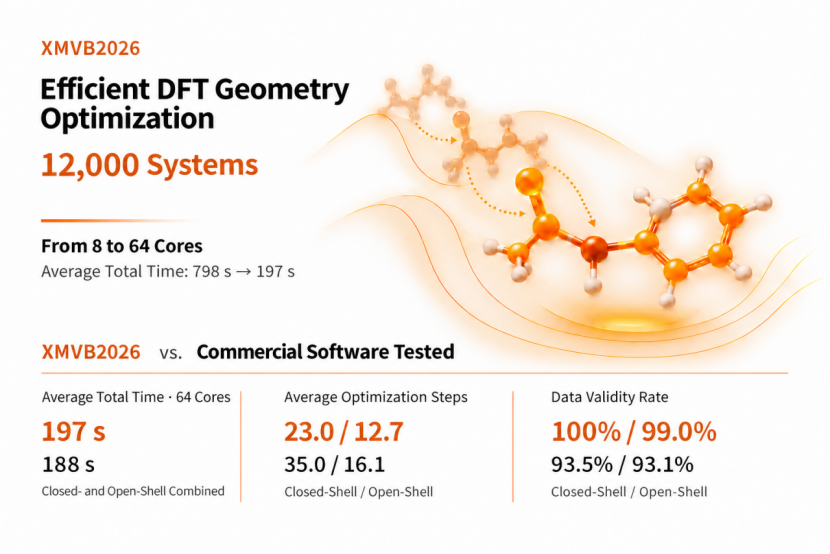
01. Efficient DFT and Geometric Optimization
02. Efficient Post-Self-Consistent Field Methods
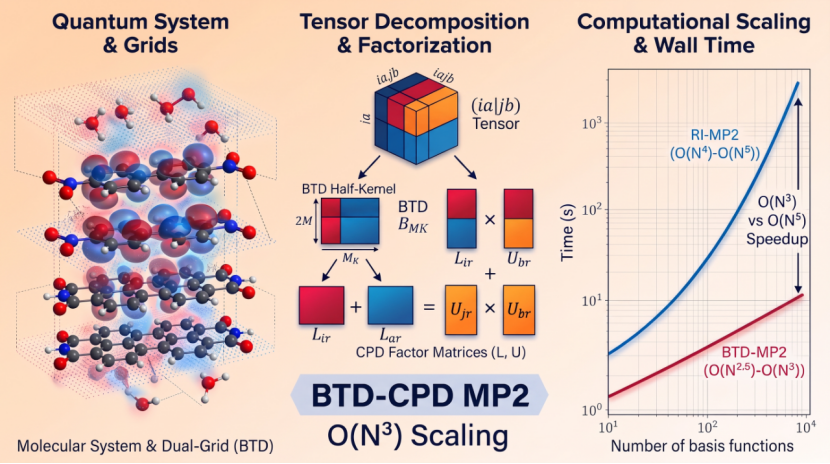
To address the high computational cost and difficulty in applying traditional MP2 methods to large-scale systems, XMVB 2026 combines the low-rank algorithms of block tensor decomposition (BTD) and canonical polyhedral decomposition (CPD) to develop an efficient post-self-consistent field method. It reduces the computational scale of traditional MP2 from O(N⁵) to strictly O(N³) with O(N²) memory usage, while achieving a single-atom error of only 0.058 kcal/mol. In large systems with over 2,000 basis functions, it significantly outperforms traditional RI-MP2, enabling efficient, high-precision calculations of electronic correlations in large molecules.
03. Computational Studies of High-Valence Bond Theory
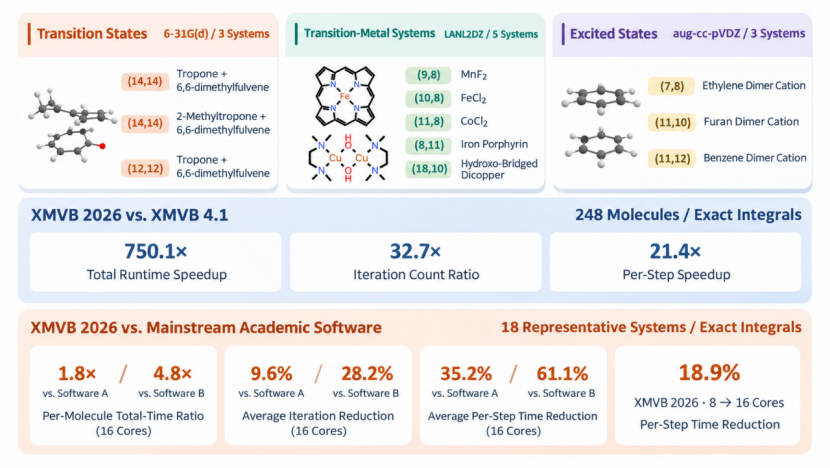
XMVB 2026 further enhances computational capabilities for valence bond theory, supporting a deeper understanding of the nature of chemical bonds and complex electronic structures. Performance tests show that, compared to XMVB 4.1, it achieved a 750.1-fold reduction in total runtime for exact integration calculations on 248 molecules; Test results for 18 representative systems show that, with the same number of configurations, the computational efficiency of the non-orthogonal orbital-based VBSCF not only rivals that of CASSCF in mainstream academic software but even outperforms it in some systems, providing an efficient and reliable computational tool for the study of complex molecular electronic structures.
04. Efficient and Versatile Energy Decomposition Analysis (EDA)
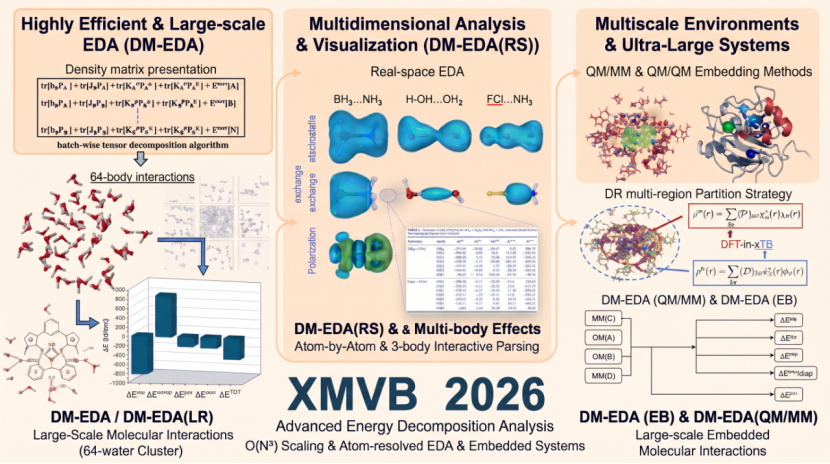
For energy decomposition analysis (EDA) of complex intermolecular interactions, a family of efficient multiscale DM-EDA methods based on density matrices has been developed in XMVB 2026.
Efficient Low-Rank Acceleration (DM-EDA(LR)): By directly manipulating fragment density matrices (eliminating the need for intermediate-state wavefunctions and complex orthogonalization) and combining this with a low-rank tensor approximation, this method achieved, for the first time, the analysis of 64-body interactions in a 64-water cluster.
Solvation Effects (DM-EDA(C-PCM)): By integrating the EDA-PCM method previously developed by our research group, we developed the DM-EDA(C-PCM) method, which provides technical support for geometric optimization, force field development, and solvation effect studies in solution-phase systems.
Real-space atomic analysis (DM-EDA(RS)): By mapping energy terms onto a three-dimensional grid, this method enables qualitative visualization and quantitative decomposition of single-atom-level and many-body effects.
Multiscale complex environments (DM-EDA(EB) & QM/MM): Combining DFT-in-xTB quantum embedding with the QM/MM framework, this approach extends to protein-ligand and solution-phase systems containing thousands of atoms and supports pseudopotentials and custom basis sets.
Machine Learning Force Fields (DM-EDA (ML)): Using EDA-decomposed data as the training target, this approach enhances the force field’s ability to describe weak interactions and improves its transferability.
05. XMVB Agent: Making Quantum Chemistry Computations More Convenient
As computational methods and analytical capabilities continue to expand, lowering the barrier to software use and simplifying complex computational workflows have become key areas of development. To this end, XMVB 2026 introduces the XMVB Computational Assistant, which provides end-to-end intelligent support and integrates core functions such as molecular structure preparation, calculation parameter configuration, input file generation, cluster job management, result analysis, and scientific report generation. Through natural language interaction driven by large language models, it automatically handles parameter configuration and workflow management for complex computational tasks, supporting Slurm job submission, runtime status monitoring, and visualization of VB/EDA computational results. Combined with knowledge base search and the ability to reproduce computational workflows from research papers, it significantly lowers the barrier to entry for quantum chemistry calculations, improves the efficiency of scientific computing, and provides users with a one-stop intelligent computing solution.

The XMVB 2026 cloud computing platform is now released, with the Sugon computing power platform launched simultaneously. We look forward to exploring new possibilities for efficient quantum chemical calculations and chemical bond analysis together with more researchers! Moving forward, we will continuously refine the functions and user experience of the XMVB cloud computing platform to further enhance its application value in computational chemistry education and research.